A polished online course can sit untouched on a hard drive for months. Educational livestreams solve part of that problem by adding something prerecorded lessons cannot fully recreate: a fixed moment, visible participation, and a real person learning or teaching alongside you.
The idea is surprisingly simple. Instead of telling students to watch a lesson whenever they have time, a live session creates a reason to show up now. A recent 2026 meta-analysis covering 31 randomized controlled studies and 3,823 learners found that synchronous webinar-based learning produced better cognitive and affective outcomes than its comparison conditions, particularly asynchronous learning.
That doesn’t mean live learning automatically beats recorded courses. Research is more nuanced. Earlier meta-analyses found only a small cognitive advantage for synchronous learning, while another review found asynchronous learning slightly stronger for knowledge outcomes, although the difference was trivial. The real advantage is often accountability, interaction, and immediacy rather than simply “learning live.”
1. Educational Livestreams Turn Study With Me Sessions Into Virtual Accountability
The biggest appeal of study with me content isn’t complicated teaching technology. It’s the feeling that somebody else is working at the same time.
A student opens a livestream, sees another person studying, starts a timer, and settles into the same work period. Nobody needs to speak constantly. The presence itself creates a small social commitment.
Research published in 2025 involving 509 Generation Z college students found that peer support in Study With Me environments was positively associated with motivation, self-efficacy, satisfaction, and engagement, while also being associated with lower test anxiety. The effects were particularly meaningful for livestream participants.
Why A Live Study Room Feels Different
A prerecorded video can accompany you, but it cannot notice that everyone has disappeared.
A live room creates a shared clock. Even if the host is quietly reading, writing, coding, or solving exercises, viewers know the session has a beginning and an end.
That makes virtual accountability less about surveillance and more about social presence.
The Timer Is More Important Than It Looks
Modern Study With Me streams often use visible timers, structured breaks, desk shots, and predictable routines.
A 2026 large-scale analysis of Study With Me content identified design elements such as timers and lighting as features associated with concentration, motivation, and community-building.
For creators, this is a useful lesson. You don’t need constant entertainment. A clean visual rhythm can be enough.
Live Does Not Mean Constant Talking
One mistake is assuming educational livestreams must resemble a nonstop lecture.
They don’t.
A productive session might use:
- 25 or 50-minute focus blocks
- short break periods
- a visible session goal
- chat check-ins between blocks
- a final progress recap
That structure creates urgency without making the stream exhausting.
2. Synchronous Learning Makes Expert Q&A More Useful Than Passive Tutorials
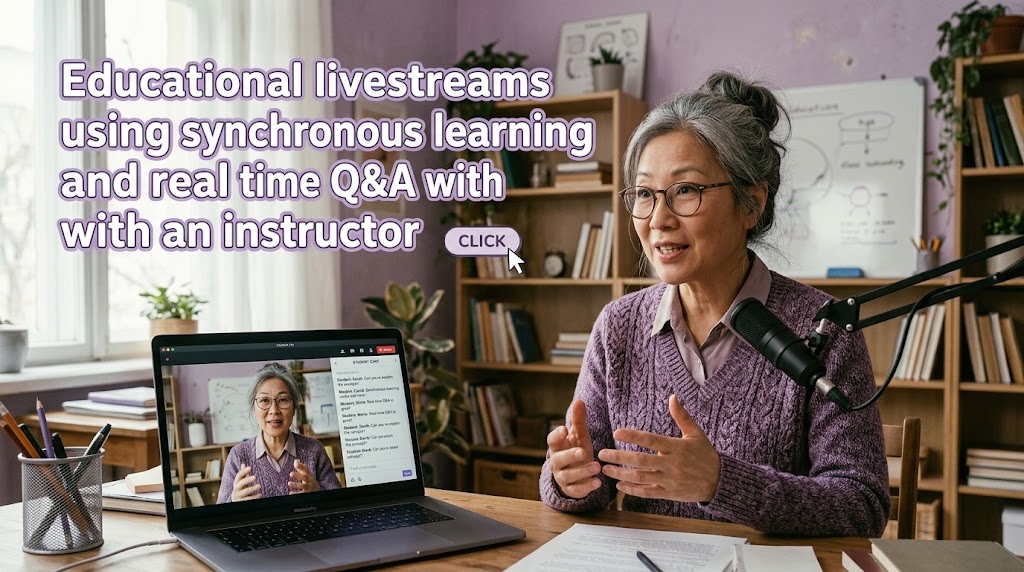
The second advantage is immediate clarification. A recorded tutorial can explain a concept beautifully, but students still have to stop, search, formulate a question, and find an answer somewhere else.
With synchronous learning, the question can enter the lesson while the problem is still fresh.
Real Time Q&A Gives Confusion Somewhere to Go
A good real time Q&A session doesn’t simply collect questions at the end.
The instructor can ask viewers what they’re struggling with, identify recurring mistakes, then adjust the explanation immediately.
This is especially valuable for subjects where context matters, including programming, design, mathematics, languages, business, and professional skills.
A 2024 study on synchronous online learning found that different engagement methods, including chat and voting, can influence student engagement.
Questions Become Part of the Lesson
Imagine a coding instructor explaining a function and five students report the same error.
That error is no longer an individual problem. It becomes today’s teaching material.
This is where live education can feel surprisingly close to a physical classroom. The teacher sees confusion, reacts, demonstrates another example, and moves forward.
The Best Q&A Is Structured
Random questions can quickly derail a livestream.
A better approach is to divide interaction into clear moments:
- Opening question to identify the audience’s level.
- Main teaching block.
- Focused Q&A around the lesson.
- Quick recap of recurring problems.
- Final questions before closing.
Creators who want to explore this format can also look at why live skill workshops can outperform passive tutorials when the subject benefits from demonstrations and immediate feedback.
3. Educational Livestreams Work Best When Accountability Supports Good Course Design
The strongest case for live education isn’t that students suddenly become more disciplined.
It’s that the environment removes some of the friction that makes self-paced learning difficult.
A course sitting inside a dashboard can always be postponed. A scheduled livestream creates a concrete event.
That difference matters, but creators should avoid turning every lesson into mandatory attendance.
Research on synchronous learning repeatedly shows that the effect depends on instructional method, course duration, learner level, and subject. In other words, simply adding a webcam doesn’t make teaching better.
Use Live Sessions For What Live Does Best
The most effective format is usually hybrid:
- Recorded content for explanations students may need to replay.
- Livestreams for demonstrations and difficult concepts.
- Live discussion for questions and feedback.
- Community sessions for motivation and accountability.
- Replay access for students who miss the session.
This gives learners flexibility without throwing away the social benefits of being together.
Accountability Should Feel Helpful
There is also a limit to pressure.
A 2025 experiment comparing Study With Me environments found that participants experienced lower perceived pressure with an SWM video than with a physical companion while achieving higher accuracy than the physical-companion condition.
That’s an important distinction.
The goal isn’t to make students feel watched. It’s to make studying feel less lonely.
What Creators Should Take From The Research
Educational livestreams aren’t replacing every online course. They’re filling a specific gap.
They work particularly well when learners need:
- Urgency to start a task.
- Interaction to solve confusion.
- Accountability to maintain momentum.
- Community to avoid studying in isolation.
- Feedback before a mistake becomes a habit.
The smartest creators therefore shouldn’t copy the classroom hour for hour. Build a live experience around what recorded content cannot easily provide.
A quiet Study With Me room, a focused expert Q&A, or a hands-on workshop can all work because the audience isn’t merely consuming information.
They’re showing up for it.
Kavya Menon is a digital audience researcher with experience studying viewer behavior across education, gaming, shopping, wellness, and entertainment livestreams.
She previously worked with a media intelligence consultancy that analyzed how people discover and interact with live content.
Her writing explores emerging livestream categories, niche communities, audience preferences, and the changing habits of viewers across different platforms.